

Who designed our houses
Gustavo Pinto and Simón Vélez. Vélez is the Colombian architect, born in Manizales, who made guadua bamboo a structural material rather than a decorative one, and he has been recognised internationally for it (Wikipedia, Dezeen). Most people who know his work know it from pavilions and public buildings. Fewer have slept in one.
Our main villa carries Pinto's name. It's a bungalow across two levels, and the bamboo and timber aren't a cladding choice applied at the end. They're what's holding the building up.
What bamboo architecture actually feels like to stay in
It feels open. That's the honest summary, and it's the thing worth knowing before you book.
A house built this way is designed to let air move through it rather than to seal itself off and then chill the result. Upstairs in Villa Pinto, two master suites frame a shared living room where the light comes through bamboo and timber details, and it changes character through the day in a way a plastered ceiling doesn't. Downstairs, a bedroom opens onto the pool and patio. All three bedrooms open onto the pool terrace, so the Caribbean breeze crosses the house.
We do have air conditioning in the rooms, and fast wifi, so this isn't an exercise in discomfort. But the design assumption is indoors and outdoors blurring rather than facing off, and guests who want a hermetically sealed hotel room are happier somewhere else.
Six rooms, three houses
That's the whole property, and it doesn't need dressing up.
- Villa Pinto: three bedrooms for up to eight, one on the ground floor and two master suites above, joined by a living room. Each has a king bed; the third also holds three single beds. Three private attached bathrooms. These are the Orquídea rooms, Estrella, Cuerno and Fuego.
- Casita Veranera: the Rhizo and Avi rooms, each with a large balcony over the Ciénaga de Cholón, plus a shared pool and rest area.
- Casita Laguna: a house of its own, with a private pool, an outdoor bathroom and a gazebo with a panoramic view over the water.
Booked together as the Full House, the six bedrooms sleep up to fourteen with every room ensuite, and there are no other guests on the property. Five of the six have king beds; the sixth is a king plus two singles.
Above it all there's a rooftop terrace looking over the mangroves to the sea. It's the best place on the property to understand the building, because from up there you can see how the houses sit into the trees rather than on top of them.
Why build like this here
Because of where here is. We're on Bahía de Cholón, on Barú Island, in the mangroves. A concrete box would work against that setting; a bamboo and timber house set among the trees is a quieter proposition, and the materials belong to the country they're standing in.
The mangroves are also what you do all day. Kayaks are available to guests, and the water is at its stillest at dawn, which is also when the birds are loudest. Our concierge can arrange kayaking, snorkelling or birdwatching. Corales del Rosario National Park, the protected reef system off this coast, is the snorkelling trip rather than a swim from the terrace, and we'll arrange the boat for it.
Sea access from the houses is direct, though unguarded, so open-water swimming is at your own risk.
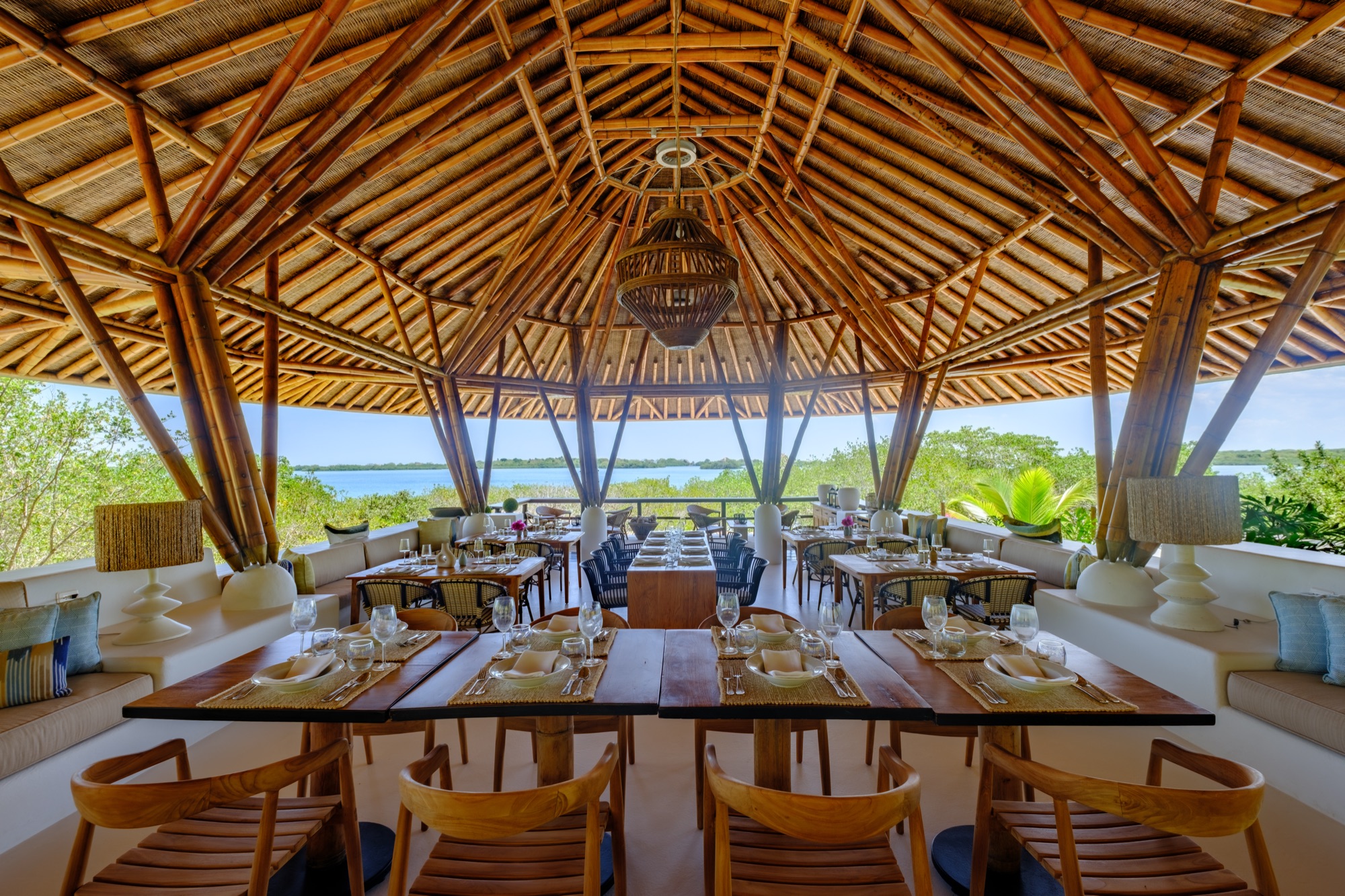
Eating under the bamboo
Chef Pedro Mosqueda leads the kitchen at our Ancalá Waterfront restaurant, premium BBQ on the mangroves with sea views. He took over from Chef Silvestre Saiz Cortázar, who built the kitchen: born and trained in Ibiza, raised in the kitchens of Bogotá.
Dietary requirements are straightforward for us. A lot of us have been vegetarian or vegan at some point and the non-meat offering is a real one, and we cook for lactose and gluten intolerance regularly. Ask us what's on during your dates, since the menu moves.
Practical things worth knowing
We don't allow smoking, we don't take pets, and we don't host events of any kind. The houses aren't step-free and there's no lift, which is a consequence of building across two levels in timber; if mobility matters, write to us before booking and we'll be straight with you about what's possible.
Getting here is a boat, about 30 minutes to an hour from Cartagena, roughly an hour door to door from Rafael Núñez International Airport. Reserve the crossing when you reserve the room, because capacity is limited.
The last note is the one Vélez's work tends to produce in people: the house is quiet, and nature is the soundtrack. Quiet hours out here are self-regulated. The mangroves set the pace and most guests stop resisting that by the second morning.