The short answer: December to April
Come between December and April. That is Cartagena's dry season, and January is typically the driest month of the year. The rainier half runs May to November, with rainfall building steadily until around October.
That is the whole calendar in two sentences. What follows is what those months actually feel like from where we are, an hour or less by boat from the city, on the Bahía de Cholón side of Barú Island.
What the dry season is like out here
Dry season means reliable mornings. It is the stretch when the water in the bay is flattest and the light is hard and clear by eight, which is why we tell guests who want to kayak the mangroves or look for birds to plan it for first thing. It is also the busiest half of the year in the city, so it is the half where reserving matters most.
One practical note, because it catches people out: our boat has limited capacity, and if you have not reserved a seat and there is no space, the wait for the next crossing is long. Reserve the crossing when you reserve the room, particularly in January and February.
What the rainy season actually means
May to November is wetter, not written off. Rain here tends to arrive as a heavy afternoon hour rather than a grey week, and it thins out again. October is the wettest part of the run, and it is the month we would think hardest about if your trip depends on being on the water every day.
The thing that changes is the crossing, not the house. Thirty minutes to an hour from Cartagena is comfortable on a calm morning and a good deal wetter when the sea is up, so on those days we would rather move you earlier or later than push out into it.
The festivals worth planning a trip around
Cartagena's calendar is real, and two of the four fixed points sit inside the dry season.
Fiestas de la Independencia, November. The city declared independence from Spain on 11 November 1811 and has thrown itself a party ever since, usually mid-November. The signature moment is El Bando: the mayor reads the proclamation at 11:30 AM on the opening day, and a parade of dance groups and floats moves along Avenida Santander to Parque de La Marina. This is the local one, not the tourism-board one. The plazas of the Walled City are genuinely packed, so book three months out and keep an eye on your pockets in the crush.
Cartagena Festival de Música, the first two weeks of January. Around twenty-seven classical concerts, with the Teatro Adolfo Mejía as the main room and tickets sold through Tuboleta. It lands in the post-Reyes peak, which is the single hardest week of the year to find a bed in the city. If you want that week, ask us by October.
Hay Festival, late January. The literature and ideas festival, a franchise of the original in Hay-on-Wye in Wales. Sessions run around USD 15, some are free, and the main ones have simultaneous Spanish and English translation. Venues are in the Walled City, including the Teatro Adolfo Mejía and the Claustro de la Merced.
Semana Santa, March or April. Holy Week is devout rather than festive: processions from Viernes de Dolores through Easter Sunday, reduced bar hours, and a partial restriction on liquor sales on Good Friday. City hotel rates rise sharply. Come for the processions, not for the nightlife. In 2026 it fell between 29 March and 5 April; the dates move each year with Easter.
FICCI, the film festival. The oldest film festival in Latin America, founded in 1960, with a Colombian and Latin American slant and the Teatro Heredia as its main venue. It has traditionally run in March, and in 2026 it moved to mid-April, so check the year you are travelling.
When we would come
Late November into early December, or February.
Late November gets you the start of the dry weather without the January prices, and the city has just come down off its own party. February is the one we recommend most often: dry, the festivals are done, and the bay is calm enough that a dawn kayak into the mangroves is a near certainty rather than a hope. If your trip is built around the Walled City rather than the water, January is the richest month culturally, and you should treat it as a booking deadline in October rather than a plan you make in December.
Getting here, whichever month you pick
From Rafael Núñez International Airport in Cartagena to our door is about an hour, and we can arrange transfers both ways. Going home, leave us three hours before your flight departs. The crossing itself is 30 minutes to an hour on our boat.
Our rate has no accommodation tax for foreign residents, and IVA is already included for Colombian residents. We charge a resort fee of USD 20 per night. City hotels are connected to public utilities; out here we are not, which is what that fee covers.
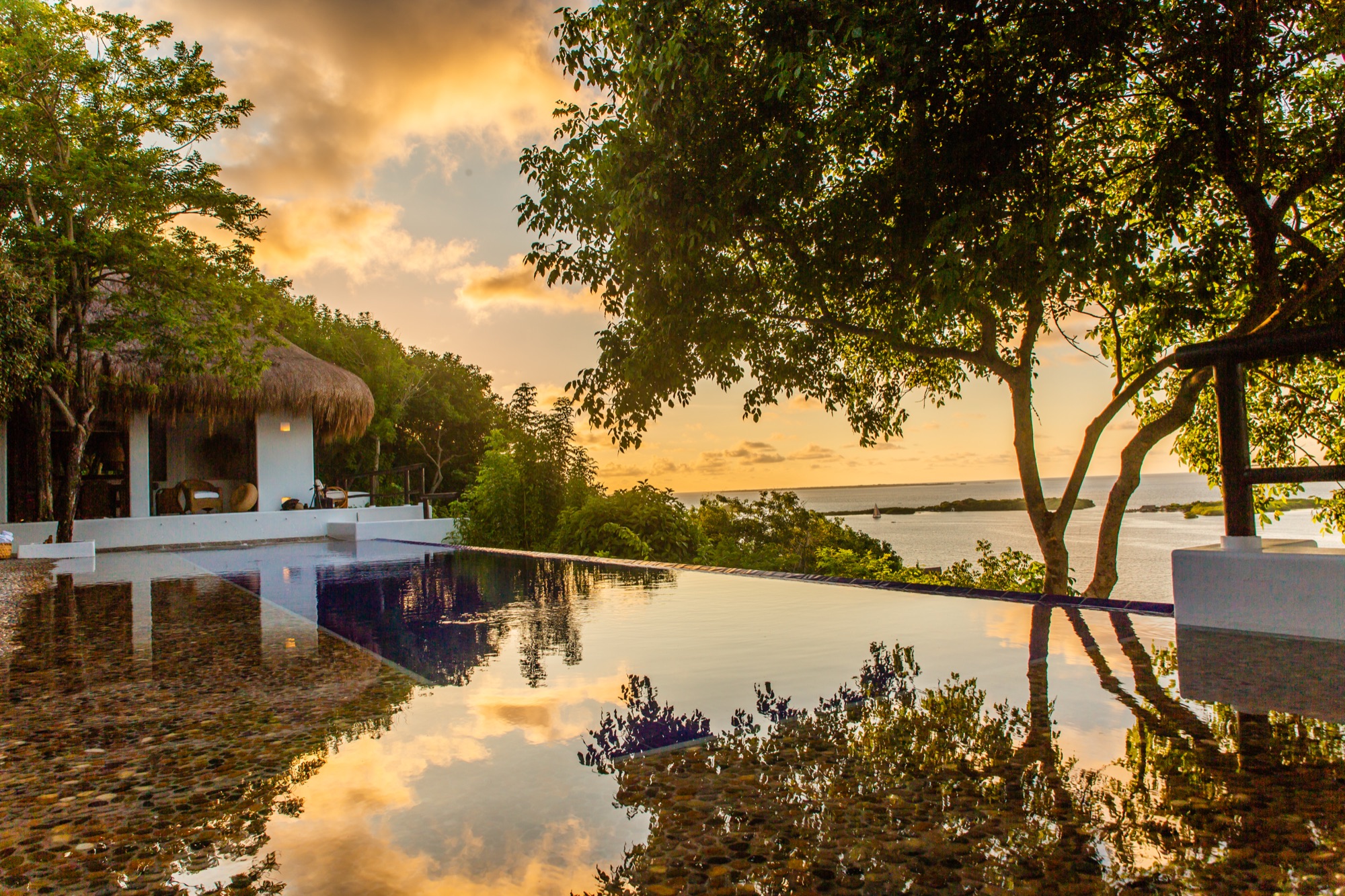
Six rooms across three houses is all we have, in any season. Villa Orquidea holds the Estrella, Cuerno and Fuego rooms, Casita Veranera holds Rhizo and Avi, and Casita Laguna sits on its own with a private pool and a gazebo over the Ciénaga de Cholón. In the dry-season weeks that is not a lot of inventory, which is the honest argument for booking early rather than a sales line.