

Six rooms, three houses, one hill
We are small, and the number is the whole story: six bedrooms, divided between three separate houses, on the hill above Bahía de Cholón on Barú Island. There is no wing, no block, no corridor. You walk between buildings, and the walk is outdoors.
That scale decides most of what follows. It is why the property can be taken whole by one group, why two families can be housed separately without being in the same building, and why we can say with confidence who is on site on any given night.
The three houses
The main villa. The principal house sits at the top of the hill and holds the three Orquídea rooms. Estrella is the family room, with a queen and two single beds, sea views and direct pool access. Cuerno and Fuego are on the second floor, opening onto a shared living room and the pool. Fuego takes a king bed. Booked whole as Villa Pinto, the house is three bedrooms with its own pool and direct sea access, sleeping up to eight.
Casita Veranera. A separate house with two rooms, Rhizo and Avi. Both have a large balcony with a panoramic view over the Ciénaga de Cholón, a swimming pool and a shared rest area. This is the house we point families and couples towards when they want their own front door without needing eight beds.
Casita Laguna. One room, standing on its own, with a private pool, an outdoor bathroom and its own gazebo looking out over the water. It's the most separate thing we have.
All six bedrooms have their own ensuite bathroom. Five of the six carry king beds; Estrella is the king-plus-two-singles configuration.
Why the houses look the way they do
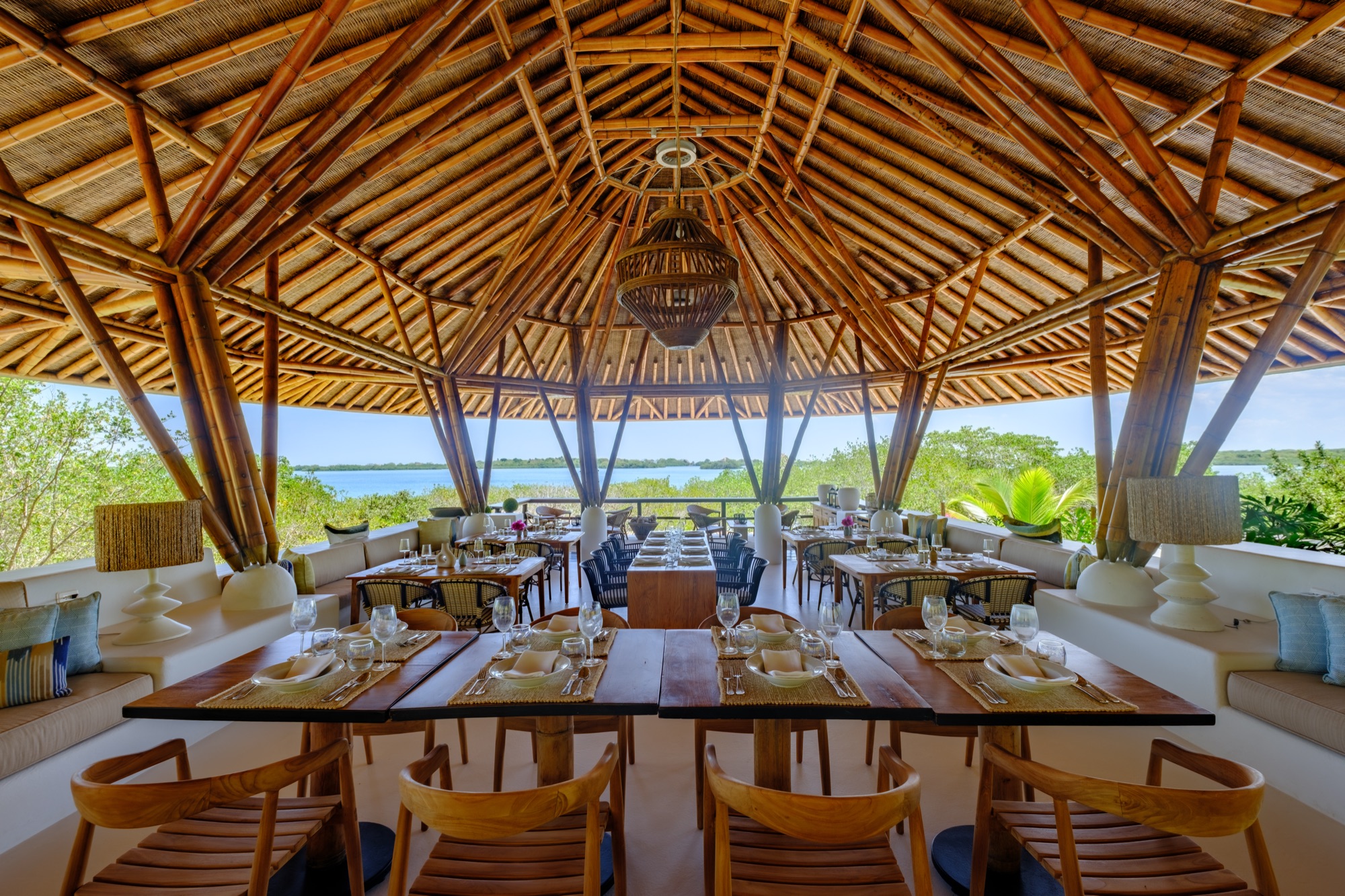
The architecture is by Simón Vélez and Gustavo Pinto, built in guadua bamboo and timber. Vélez is the architect most associated with structural bamboo in Colombia, and the material dictates the buildings: wide spans, deep roofs, and rooms that open to the air rather than seal against it. Air conditioning is in the bedrooms, but the living spaces work because the breeze moves through them.
If you have seen photographs of this property, the ceilings are what you remember. They're the structure, not a finish applied over one.
Booking one room or all of them
Three ways to stay, and they suit different trips.
| How you book | What you get | Sleeps |
|---|---|---|
| A single room | One bedroom with ensuite, shared pool and living areas in that house | 2 to 4 |
| One house | Villa Pinto, Casita Veranera or Casita Laguna to yourselves | 1 to 8 |
| Full House | All six bedrooms, the pool, rooftop terrace, living and dining rooms, no other guests on site | Up to 14 |
Groups often ask whether they can split across two buildings. They can, and it's worth planning deliberately: the main villa is its own villa with all the Orquídea rooms, and Casita Veranera is separate, so one party can have the main house while the other takes a Veranera room or Casita Laguna.
The Full House is a full buyout. No other guests, concierge service, nightly turn-down, kayaks from the house. No events, no pets and no smoking anywhere on the property.
The kitchen
Our kitchen was built by Chef Silvestre Saiz Cortazar, born and trained in Ibiza and raised in the kitchens of Bogotá. Pedro Mosqueda has since taken over as Executive Chef. The Ancalá Waterfront restaurant is ours, at the water's edge.
On dietary requirements we are straightforward. A lot of us have been vegetarian or vegan at some point and we're proud of the non-meat offering. If you're lactose or gluten intolerant, tell us when you book and it is handled rather than improvised on the day.
Getting to us
The crossing is 30 minutes to an hour from Cartagena on our boat. From Rafael Núñez International Airport, door to door is about an hour, and we ask you to leave us three hours before your flight on the way out. We can arrange transfers both directions.
Reserve the boat when you reserve the room. Capacity is limited, and if you aren't on the list and there's no space, the wait for the next crossing is a long one.
What we are not
We are not a resort, and the island is not a resort strip. Sea access from the houses is direct and unguarded, so you swim at your own risk. The houses are not step-free and there is no elevator. The village of Bocachica, which many guests visit, has no running water and no paved roads, and we'd rather you knew that before the boat than after it.
Foreign residents pay no tax on hotel accommodation in Colombia. For Colombian residents, IVA is already included. We charge a resort fee of 20 USD per night, because city hotels are connected to public utilities and out here we are not.
Six rooms across three houses. That's the whole property, and it doesn't need dressing up.