What Corales del Rosario actually is
It is Colombia's only underwater national park. That single fact explains most of what surprises people about it. Parque Nacional Natural Corales del Rosario y San Bernardo was declared in May 1977 to protect the reef around one island of the Rosario archipelago, covering 178 square kilometres at the time. It was enlarged in 1988, and again in 1996, when the San Bernardo archipelago was folded in and the park reached its present size of 1,200 square kilometres. The great majority of that area is water, not land, and the reefs it protects sit between one and thirty metres down.
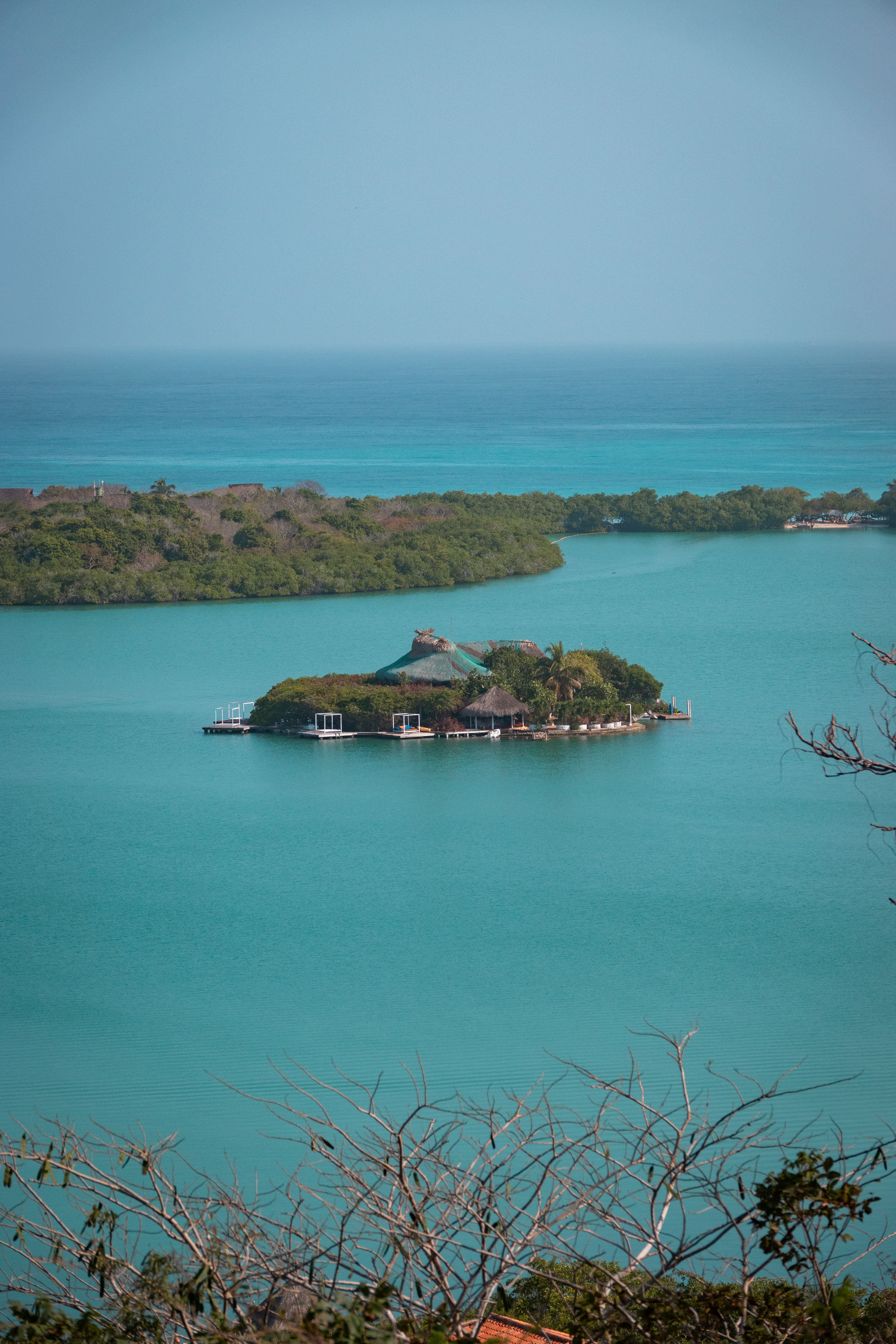
So there is no gate, no trail map and no summit. The park is the sea, and the islands in it are small, low and mostly fringed with mangrove.
Where it sits, and where we sit
The park lies roughly 45 kilometres from the Bay of Cartagena, out along the same stretch of Caribbean coast that we look at every morning. We're on Bahía de Cholón, on Barú Island, and the park is one of the nearest places to us. From Cartagena, the journey to our door takes 30 minutes to an hour on our boat, and from the airport it is about an hour door to door.
We'd ask you to reserve that crossing rather than assume it. Our boat has a limited capacity, and if you arrive unreserved and there's no space, the wait for the next one is long. It is the one piece of planning that changes your first day more than any other.
What you'll actually see underwater
Fish, in numbers. The park records 170 species of fish, 52 species of coral, 25 species of sponge, and hundreds of species of molluscs and crustaceans. Above the waterline the vegetation is mangrove and seagrass rather than forest, and there is no fresh water anywhere in the park, only brackish lagoons on some of the islands.
The water is warm enough that most people stay in it far longer than they planned. The yearly average runs between 27 and 30 degrees Celsius, which is to say you will not be thinking about a wetsuit.
One honest caveat, because you'll read the opposite in a brochure. The reef is under real pressure. The Canal del Dique carries sediment from the Magdalena River into these waters, and that sediment is measurably degrading the coral. Visibility and reef condition vary a great deal from one spot to another and from one day to another. Some of what you see will be extraordinary. Some of it will be the reef having a hard time, and it is worth going with that in mind.
It is popular, and that is part of the picture
In 2009 it was the most visited national park in Colombia, with 318,473 visitors in the year. Nothing since has made it quieter. The busiest water is not usually the water in front of a house on Cholón, but if you go out to the better-known islands in the middle of the day you will be sharing them.
Early is the answer to almost every version of this problem here. The light is better before nine, the water is flatter, and the boats that left Cartagena after breakfast have not arrived yet.
Planning a day out on the water
This is the part we'd rather talk through with you than guess at in writing. Conditions, operators and what's running change through the year, so write to us before you arrive and we'll go through what makes sense for the days you're here. We will not pretend a day of flat glass is guaranteed in December any more than it is in May.
What we can say plainly is that you do not have to go far to be in this landscape. The mangroves of Barú are on our own doorstep, and dawn there, with a kayak and no engine noise, is the version of this coast that most people remember afterwards. The park's reefs are the louder attraction. The mangrove is the quieter one, and it is closer.
A note on where you stay
Six rooms across three houses is the whole of us: Villa Orquidea, Casita Veranera and Casita Laguna, with Villa Pinto the three-bedroom house designed by Simón Vélez and Gustavo Pinto in guadua bamboo, sleeping up to eight with its own pool and sea access. Casita Laguna has a private pool, an outdoor bathroom and a gazebo looking over the Ciénaga de Cholón. The whole place can be taken as one villa if you are a group, which is how a lot of families here end up using it.
Our kitchen was built by Chef Silvestre Saiz Cortázar, born and trained in Ibiza and raised in the kitchens of Bogotá, and Pedro Mosqueda has since taken over as Executive Chef. If you are vegetarian, vegan, lactose intolerant or gluten intolerant, say so when you book and it is handled without ceremony.
A practical last point: foreign residents pay no tax on hotel accommodation in Colombia, and for Colombian residents IVA is already included in our rates. We charge a resort fee of 20 USD per night. On an island, the utilities that a city hotel simply plugs into are ours to run.