The short answer
They are two different places, and the difference is scale. Barú is one large island south of Cartagena. The Rosario Islands are an archipelago of around 27 much smaller islands lying offshore, inside the Corales del Rosario y San Bernardo national park. If you want space, a longer stay and a shorter crossing, Barú is the answer. If you have come for reef and snorkelling above all else, the Rosarios are.
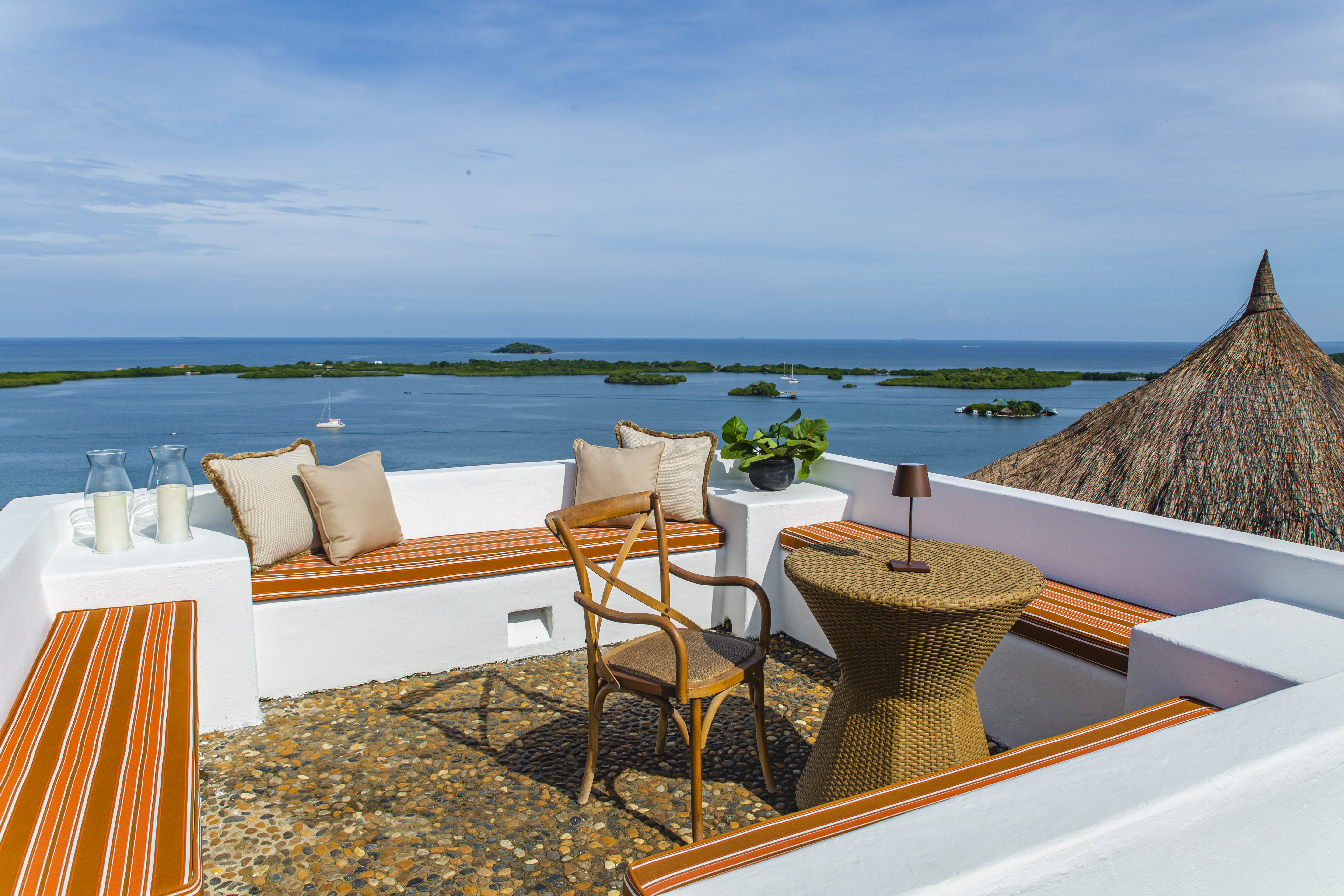
We're on Barú, on the water at Bahía de Cholón. Our boat takes 30 minutes to an hour from Cartagena, depending on the sea.
Side by side
| Barú | The Rosario Islands | |
|---|---|---|
| What it is | One large island south of Cartagena | An archipelago of around 27 small islands offshore |
| National park | Sits adjacent to the Corales del Rosario y San Bernardo park | Lies inside it |
| Character | Varies enormously end to end, from beach clubs to quiet bays | Small, low and reef-facing |
| Best for | Longer stays, families, groups taking a whole house | Snorkelling, diving, day trips |
| Our crossing | 30 minutes to an hour on our boat | Further out again |
What Barú actually is
Barú is big, and that single fact explains most of what people find confusing about it. One island holds parts that have almost nothing in common with each other. Playa Blanca, at the north-western end, is the Barú most visitors meet: a long pale beach lined with beach clubs and day-tour arrivals, loud by late morning and quiet again by five. It is a genuine sight and it is also the busiest thing on the island, which is worth knowing before you plan a week around it.
Bahía de Cholón, where we are, is a different proposition. The water here sits in a bay rather than on open sea, and the shoreline is mangrove rather than sand. That is not a consolation prize, it is the reason the birdlife is what it is and the reason the water is flat at dawn. We say this plainly because it matters to your booking: if your picture of the trip is walking out of your room onto a beach, Cholón is not that, and you should know it now rather than on arrival.
What the Rosario Islands actually are
The Rosarios are a scatter of around 27 islands further out from the coast, and they sit inside the Corales del Rosario y San Bernardo national park. That protected status is the point of them. It is why the reef is there and why the snorkelling that people travel for is concentrated around these islands rather than along Barú's shore.
They are small. Most of them hold one property, or a few, and the horizon is close on every side. For two or three days of water, that is a fine way to live. For a week with children or a group that wants to spread out, the same smallness becomes the constraint.
How you get to each one
Everything out here arrives by water, and the crossing is the part people underestimate. Our own boat runs between Cartagena and our dock in 30 minutes to an hour, which is a short enough hop that you can be in the walled city for lunch and back with us by evening if you plan it. The Rosarios sit further out again, so build in a longer sit on the water each way.
One practical note. Our boat has limited capacity, so reserve your seat when you book your room. If there's no space you're waiting a long time for the next crossing, and that is an avoidable way to start a holiday. Door to door from Rafael Núñez International Airport to us is an hour, and going the other way you should leave us three hours before your flight departs.
Which one suits which trip
Stay on the Rosarios if the reef is the reason you're coming, if you're happy to organise your days around boats, and if two or three nights is the shape of the trip. You'll be closer to the coral than anywhere on Barú.
Stay on Barú if you want more than one kind of day, if you're travelling with a group who won't all want the same thing, or if you want to keep Cartagena within easy reach. The island is large enough that you can have a quiet bay and a busy beach in the same stay.
And the honest version: most people who ask us this question are choosing between a short water-focused break and a longer stay with people they like. That, more than geography, is the decision.
Where we sit in all this
We're six rooms across three houses on the water at Bahía de Cholón: Villa Orquídea, Casita Veranera and Casita Laguna. The architecture is by Simón Vélez and Gustavo Pinto, built in guadua bamboo, which is why the ceilings behave the way they do in the heat. Villa Pinto is the three-bedroom house with its own pool and direct sea access, and Casita Laguna has a private pool, an outdoor bathroom and its own gazebo over the bay.
The whole place can be taken as one villa, six bedrooms, which is how most larger groups use us. Our kitchen was built by Chef Silvestre Saiz Cortázar and Pedro Mosqueda is now our Executive Chef. If anyone in your party is vegetarian, vegan, lactose intolerant or gluten intolerant, tell us in advance and it is handled; a fair number of us have eaten that way at some point ourselves.
If you want the mangroves rather than the reef, the kayaking at dawn is the thing we'd point you at first.